MANICURE TROUBLESHOOTING
Why Does Nail Polish Wrinkle After Top Coat?
Wrinkled nail polish usually means one layer moved or dried faster than the softer polish underneath. Here is how to identify the cause, smooth minor ripples, and stop the problem from returning.
QUICK ANSWER
Why top coat can make nail polish wrinkle
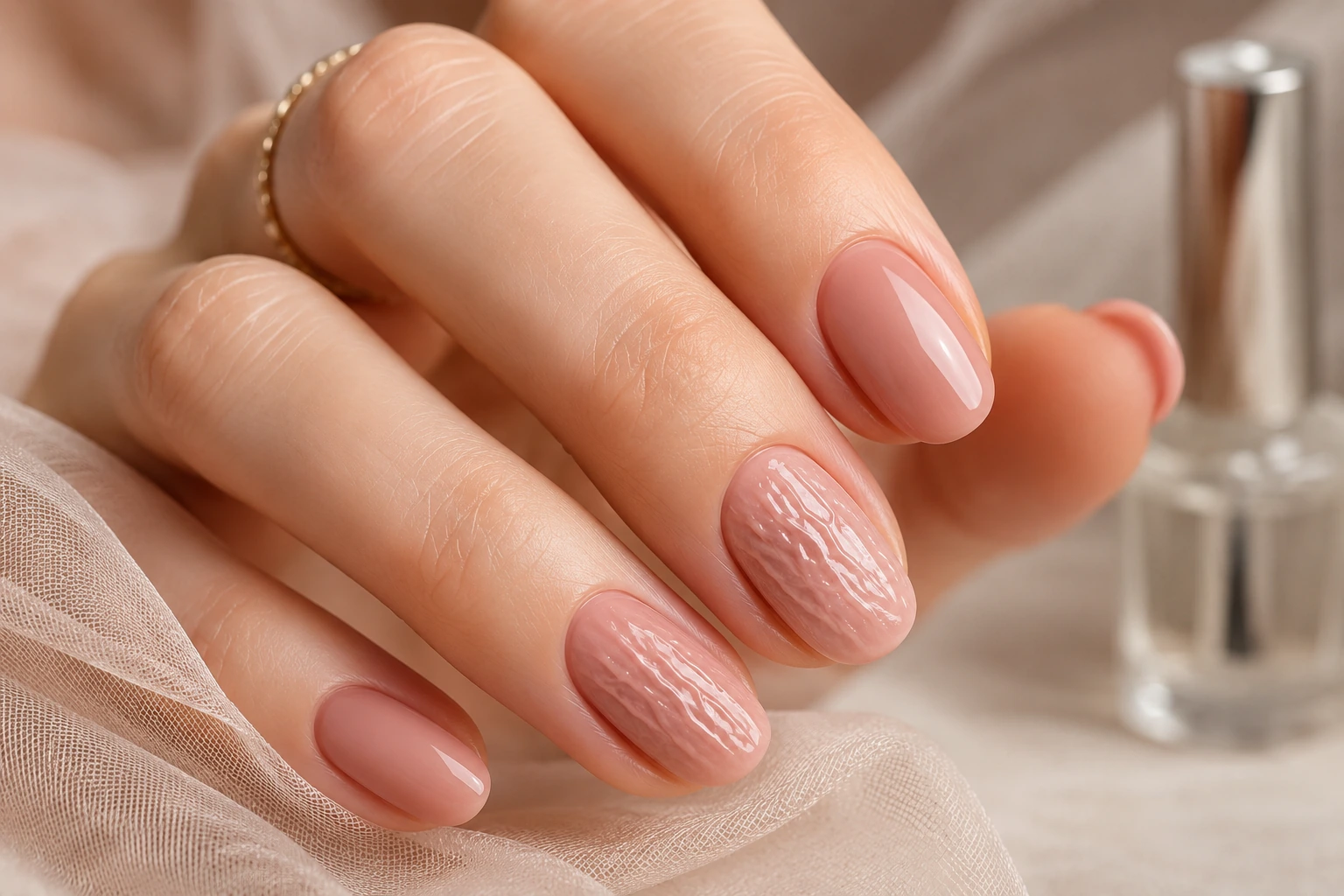
Nail polish commonly wrinkles after top coat when the colour coats are too thick, the lower layers are still soft, the top coat is applied with too much pressure, or another top-coat layer is added before the first has set. The top surface begins to firm while the softer polish underneath can still move, creating ripples, folds, or a pushed-up texture.
For a minor ripple, let the manicure dry completely and apply one thin smoothing layer of compatible top coat later. If the polish is deeply folded, gummy, or sliding on the nail, removal and repainting will usually give a cleaner result.
You finish a manicure, glide on top coat, and suddenly the smooth colour underneath looks crumpled. Sometimes the polish wrinkles immediately under the brush. In other cases it looks fine at first and develops ripples later.
The problem is usually not permanent nail damage. It is a drying and application issue within the polish layers. The important first step is to decide whether you are seeing true wrinkling, ordinary smudging, bubbles, or top-coat shrinkage because each problem needs a slightly different fix.
IDENTIFY THE PROBLEM
Is it wrinkling, bubbling, smudging, or shrinkage?
| What you see | Most likely problem | Typical clue |
|---|---|---|
| Folded lines or a rippled surface | Wrinkling | The polish appears to move under the top-coat brush |
| Round raised dots | Bubbling | Small bumps appear as the polish dries |
| A dent, fingerprint, or fabric mark | Smudging or compression | The manicure was touch-dry but still soft underneath |
| A visible gap near the tip or sidewalls | Top-coat shrinkage | The top coat pulls the colour inward instead of folding it |
| A puckered gel surface after curing | Possible under-curing | The issue appears after a UV or LED lamp cycle |
This article focuses mainly on traditional air-drying nail polish. UV or LED gel polish behaves differently, so see the gel-polish section before trying to correct it.
THE MOST LIKELY REASONS
Seven reasons nail polish wrinkles after top coat
The colour coats are too thick
A thick coat can form a skin on top while remaining soft underneath. When top coat is brushed over that unstable layer, the surface may shift and bunch up. Two or three thin coats are generally easier to control than one heavy coat.
The timing does not suit the top-coat formula
Top coats are not all used in exactly the same way. Some quick-dry formulas are designed to be applied while colour is still slightly tacky, while other clear coats perform better over a more settled surface. Applying a product too early or too late for its instructions can encourage dragging, shrinkage, or wrinkling.
A second layer of top coat was applied too soon
One top-coat layer may be firming while the manicure underneath is still moving. Adding another wet layer can catch the first layer and push it across the nail. Unless a product specifically calls for two coats, begin with one even layer.
The brush is touching the colour too firmly
Repeated brush strokes can disturb semi-dry polish. Try “floating” the top coat: keep a generous bead on the brush and glide it over the nail with light pressure instead of repeatedly pressing and correcting the same area.
The top coat has become thick or stringy
A gloopy top coat does not level as easily and may pull at the colour beneath it. If the manufacturer allows it, use the correct nail-polish thinner rather than acetone. Acetone is a remover and can change the product rather than simply restore its original consistency.
There are too many wet layers on the nail
Base coat, several colour coats, nail art, glitter smoother, and multiple clear coats can create a manicure that feels dry on top while remaining soft below. Simplifying the layer count often solves the issue.
The room conditions are slowing evaporation
Traditional nail polish hardens as solvents evaporate. Heavy coats, heat, humidity, and limited airflow can make the lower layers stay soft for longer. Avoid painting directly beside a heater or in a steamy bathroom, and do not rely on a UV lamp to cure ordinary lacquer.
SAVE OR REPAINT?
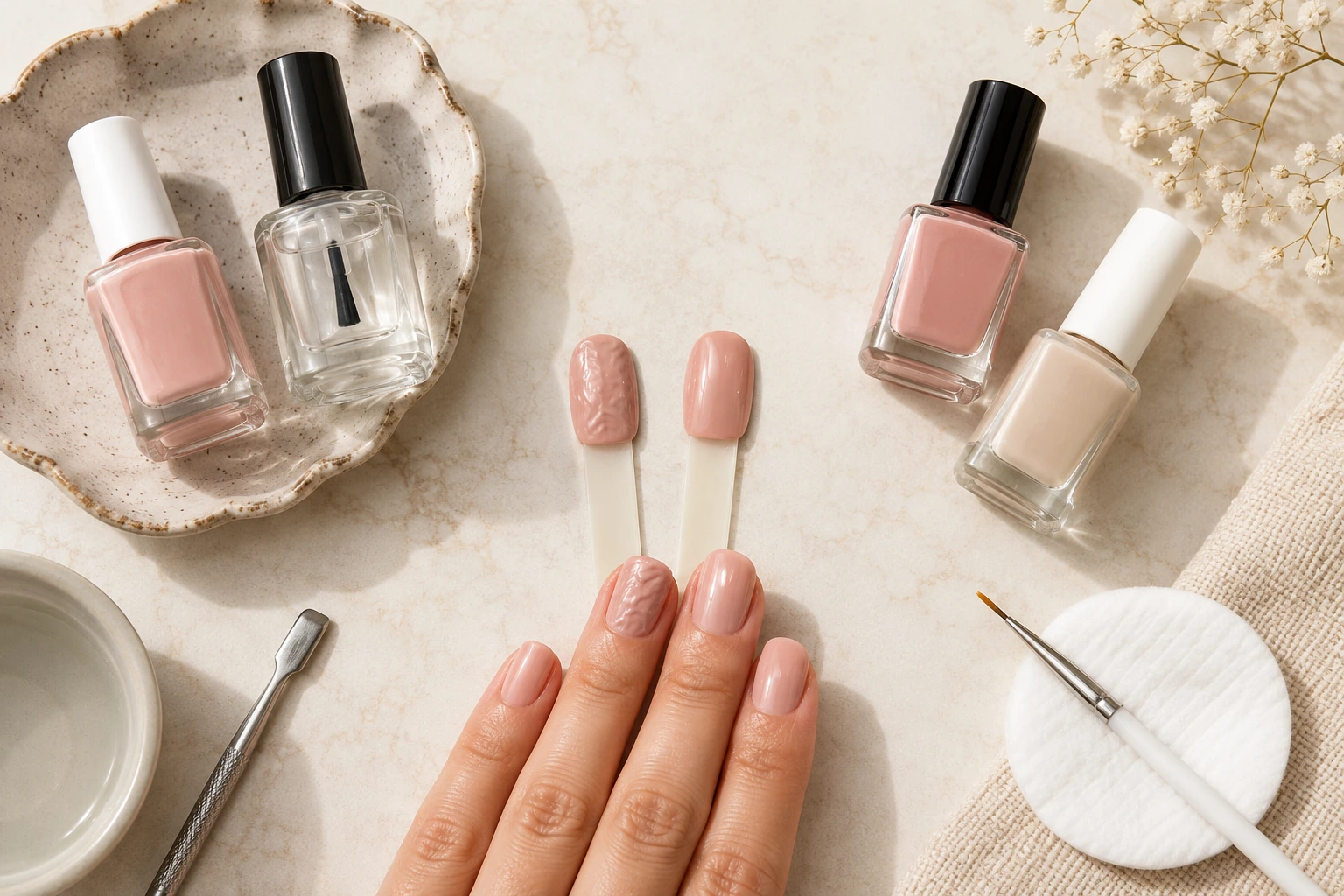
How to fix wrinkled nail polish
MINOR RIPPLE
Let it harden before smoothing
- Stop brushing as soon as you notice the wrinkle.
- Leave the manicure alone until it is fully firm, not merely touch-dry.
- Apply one thin coat of a compatible smoothing or glossy top coat.
- Use light pressure and avoid going back over the same area.
DEEP FOLDS OR GUMMY POLISH
Remove and repaint the affected nail
- Allow the layers to settle enough that removal is not excessively messy.
- Remove polish from the affected nail without scraping the nail plate.
- Wash away residue and let the nail surface dry.
- Reapply base coat and two thin colour coats.
- Finish with one correctly timed top-coat layer.
A MORE RELIABLE METHOD
How to stop nail polish from wrinkling next time
-
1
Start with a clean, dry nail
Remove oil and old polish residue before applying a thin base coat.
-
2
Use thin colour coats
Do not force full opacity in one heavy layer. Build coverage gradually.
-
3
Follow the top coat’s own directions
Quick-dry and standard top coats can have different timing requirements.
-
4
Float one even top-coat layer
Use enough product to glide smoothly without pressing into the colour.
-
5
Give the manicure time to harden
Touch-dry polish can still dent or shift. Avoid tight shoes, bedding, hair, and pressure on the nails while the lower layers continue to set.
BEGINNER TIP
Test one nail before changing the whole routine
When trying a new top coat, apply it to one finished nail first. If it wrinkles, bubbles, or pulls the colour, you can adjust the timing or layer thickness without affecting the full manicure.
IMPORTANT DISTINCTION
What if gel polish wrinkles after curing?
Gel polish that wrinkles under a UV or LED lamp may be under-cured. The surface can harden faster than the product beneath it, especially when coats are thick or the lamp and gel system are not compatible.
Do not cover a suspiciously soft or wrinkled gel layer with more product. Follow the gel manufacturer’s removal instructions, use thin layers, and use the lamp recommended for that system. Avoid getting uncured gel on the surrounding skin.
For safe removal guidance, read our step-by-step gel nail polish removal guide .
RELATED MANICURE HELP
Build a smoother at-home manicure routine
QUICK ANSWERS
Nail polish wrinkling FAQ
Why did my nail polish wrinkle as soon as I applied top coat?
The top-coat brush may have disturbed a thick or unstable colour layer. Too much brush pressure, repeated strokes, or unsuitable application timing can move the polish and create folds.
Can top coat fix wrinkled nail polish?
A thin top-coat layer may smooth a very minor ripple after the manicure has fully hardened. Deep folds, sliding polish, or a gummy surface are usually better removed and repainted.
Should nail polish be completely dry before top coat?
Follow the instructions for your specific product. Some quick-dry top coats are designed for slightly tacky polish, while standard clear coats may need a more settled colour layer.
Why does only one nail wrinkle?
One nail may have received a thicker colour coat, more top-coat pressure, or an extra brush stroke. Thumbs also sometimes receive heavier coats because their nail surface is larger.
Why does a second coat of top coat wrinkle my manicure?
The first clear layer and the colour beneath it may still be soft. A second wet layer can catch the surface and push it into ripples. Wait until the manicure is fully firm before refreshing top coat.
Will a UV lamp dry regular nail polish?
Standard nail lacquer is not formulated to cure in a UV or LED lamp. It dries mainly through solvent evaporation. Use a product intended for regular polish, such as a compatible quick-dry top coat or drying drops.
KEEP THE NEXT MANICURE SIMPLE
Thin coats and light brush pressure solve most wrinkling
Begin with fewer layers, use the top coat as directed, and let the finished manicure harden before adding another clear coat.